- Exponential Edge
- Posts
- Choose Your Own Risk
Choose Your Own Risk
Why DeFi's one-size-fits-all yield model is finally getting an upgrade

Exponential.fi
March 03, 2026
Disclosure: This newsletter is for informational purposes only and does not constitute financial advice. Always DYOR before making any investment.
Each week in Edge, we share data-driven insights, highlight risk ratings, and showcase new product updates.
Let’s dive in 👇

The One Size Fits Nobody Problem in DeFi
Here's a question that doesn't get asked enough in DeFi: why does every depositor in a yield strategy take on the same risk?
If you stake into Ethena's sUSDe or Neutrl's sNUSD, you're earning the same yield as everyone else, as well as absorbing the same downside. There's no way to say "I want the yield but with more protection" or "I'll take more risk if you pay me for it." You're all in the same boat, whether you're a treasury looking to park $10M conservatively or a degen optimizing every basis point.
In traditional finance, this problem was solved decades ago with a concept called tranching, or slicing a pool of cash flows into layers with different risk-return profiles. Senior tranches get paid first and carry less risk. Junior tranches absorb losses first but earn a premium for doing so. It's the backbone of structured credit, mortgage-backed securities, and CDOs/CLOs—a multi-trillion dollar market.
DeFi hasn't had a credible version of this. Until now.
Enter Strata

Strata is a generalized risk-tranching protocol that takes any yield-bearing strategy and splits it into two tokenized tranches: a Senior tranche for capital preservation and a Junior tranche for leveraged upside. Both are ERC-4626 vault tokens that are composable, permissionless, and tradeable across DeFi. The protocol launched in October 2025 on Ethena's USDe and has since expanded to Neutrl's NUSD, currently holding over $180M in TVL across both markets.
The core insight is simple: not every yield source needs tranching, but many of the most popular ones do. Consider Aave USDC lending where depositors are already effectively senior lenders, protected by overcollateralized loans and the Umbrella safety module. There's no real need to split that risk further.
But yields from strategies like Ethena's delta-neutral basis trade, Neutrl's OTC arbitrage, or unsecured lending protocols? Those carry meaningfully more risk. Every depositor is effectively a junior lender already and exposed to the full downside with no structural protection. These are exactly the yields that benefit from being tranched into explicit risk tiers.
How It Works Under the Hood
When you deposit into a Strata market, your capital flows through a smart contract that handles accounting, strategy management, and yield distribution. All deposited collateral is pooled and staked into the underlying yield-bearing asset (sUSDe or sNUSD). The magic happens in how the yield gets split.
The Senior Tranche (srUSDe / srNUSD) is designed for capital preservation. It earns a guaranteed minimum yield tied to a benchmark rate. For the USDe market, that's the Aave USDC/USDT lending rate; for NUSD, it's the sUSDe APY. The senior tranche's exchange rate only goes up, and upside participation is uncapped. If the underlying yield exceeds the benchmark, seniors share in the excess. If it falls below, the junior tranche subsidizes the difference.
The Junior Tranche (jrUSDe / jrNUSD) is the other side of the trade. It absorbs residual yield after the senior tranche is paid, and absorbs shortfalls when the underlying APY drops below the benchmark. In good times, junior holders earn leveraged upside. In bad times, they're the first-loss buffer for the seniors. Think of it as a liquid insurance pool that gets paid a risk premium.

Table shows estimated APYs of senior and junior tranches under different underlying APY, benchmark rate and senior TVL ratio scenarios.
The distribution between tranches is governed by a Dynamic Yield Split (DYS) mechanism. DYS continuously recalculates how yield flows between tranches based on four inputs: the underlying APY, the benchmark rate, the relative TVL ratio between senior and junior, and a set of risk-premium parameters. As more capital flows into the senior tranche and the junior gets thinner, the risk premium paid to juniors rises, a self-balancing incentive that attracts capital to wherever it's needed most.
The Neurl Example
The Neutrl sNUSD market illustrates this well.

Going directly to Neutrl and staking sNUSD, you'd earn roughly 7.8% APY on OTC arbitrage yield. Not bad, but you're taking the full risk of the strategy with no protection layer.

Strata lets you express a preference. The senior tranche (srNUSD) currently yields around 6.2% APY, which is a bit less than going direct, but with a guaranteed minimum yield floor. Even if sNUSD's underlying yield went negative, junior depositors would subsidize the senior's benchmark return. For a treasury or conservative allocator, that trade-off is compelling.
The junior tranche (jrNUSD), meanwhile, yields roughly 10.2% APY, significantly more than the raw sNUSD rate. Junior holders earn that premium because they're providing first-loss protection to the seniors. They're explicitly getting compensated for the risk that everyone in the un-tranched pool was already taking for free.
Same underlying yield. Three very different risk-return profiles. That's the power of tranching.
Why This Matters Right Now
In a raging bull market, nobody thinks about risk segmentation, Users just want the highest number. But in the current environment, where yields are compressing and capital is more cautious, the ability to choose your risk exposure becomes a genuine unlock.
Risk tranching is the missing layer that could bring a much wider range of capital into DeFi. Institutional allocators, treasury managers, and conservative depositors have long needed a way to access onchain yield without taking on undifferentiated risk. Strata is the first protocol to offer that at a meaningful scale, and if the model works, it won't be the last.
Explore Strata at app.strata.markets

yoUSD: Fully exited InfiniFi liUSD and Maple syrupUSDC/USDC. Both positions were rerated due to significant offchain exposure and junior tranche risk. InfiniFi's 1-week lock and subordinated position no longer fit the vault's risk framework, and the downstream rerating of Maple's Syrup (due to onboarding of XRP collateral) drove a similar exit. Freed capital was redeployed into Morpho lending venues where borrowing demand and collateral quality remain strong, including the Re Ecosystem USDC vault (lending against reUSD, itself a senior tranche asset), Sentora PYUSD, and Clearstar High Yield USDC. Aave sGHO allocation was also scaled up to capture improved rates.


yoETH: Exited Gearbox kpk ETH and Morpho wstETH/WETH on Base as yields compressed below competitive thresholds. Capital was concentrated into stETH discount capture strategies. Lido stETH allocation increased significantly as the vault took advantage of discounted stETH available on secondary markets, while Origin stETH Redemptions was also scaled up. Origin's ARM vault automates this process by purchasing discounted stETH and unstaking directly, converting the discount into yield. Morpho Gauntlet WETH on Unichain was also scaled up as lending demand continued to grow.

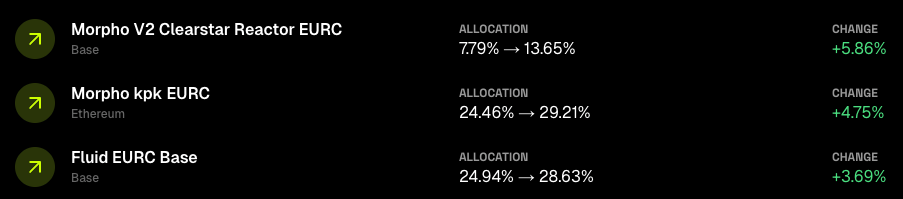
yoEUR: Fully exited Morpho V2 Steakhouse Prime EURC on Base after incentives ended. Capital was rotated into higher-yielding Morpho EURC curators, Clearstar Reactor on Base and kpk EURC on Ethereum, which both saw meaningful increases as borrowing demand across EURC markets remained strong. Fluid EURC on Base was also scaled up.


Latest updates in the YOverse 👇
yoGOLD is now out of predeposit phase and earning 1.5% native yield!
Major shake-up at Aave as the influential ACI governance contributor exits the DAO 👀
Let us know how we did 👇Provide your feedback on today's issue of the Exponential Edge newsletter. (1 ⭐️ - not useful at all, 5 ⭐️ - extremely useful) |